A solar photovoltaic (PV) system is often perceived as a simple conversion of sunlight into electricity. In practice, however, the journey of energy from solar radiation to usable electrical power involves multiple stages, each introducing unavoidable losses. Understanding these losses is critical for system designers, engineers, auditors, and sustainability professionals, as it directly influences system sizing, performance ratio, financial returns, and long-term reliability.
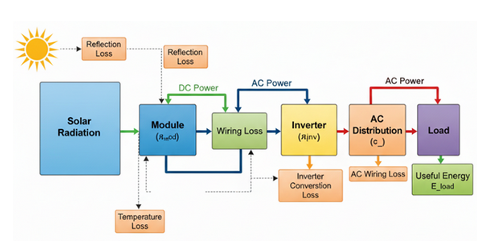
The energy flow begins with solar radiation, which represents the total incident sunlight available at the module surface. Not all incoming radiation is effectively utilized. A portion is immediately lost due to reflection losses, where sunlight is reflected off the glass surface of the PV module rather than absorbed by the solar cells. Factors such as module glass quality, anti-reflective coatings, angle of incidence, and dust accumulation influence this loss. High-quality modules typically minimize reflection losses through advanced surface treatments, but they can never be eliminated entirely.
Once radiation enters the module, it is converted into DC electrical power by the photovoltaic cells. At this stage, temperature losses become significant. Solar modules are tested at Standard Test Conditions (STC), typically 25°C cell temperature. In real-world installations, rooftop modules often operate at much higher temperatures, especially in tropical and arid climates. As temperature rises, module voltage decreases, resulting in reduced power output. This is why module temperature coefficients are a key parameter in PV design and why proper ventilation and mounting height are essential.
The DC power generated by the modules then travels through cables to reach the inverter. During this stage, DC wiring losses occur due to conductor resistance. These losses depend on cable length, cross-sectional area, material (copper or aluminum), current magnitude, and installation quality. Poor cable sizing or excessive routing distances can significantly increase resistive losses and reduce system efficiency. Industry best practices typically limit DC losses to 1–2% through optimized cable design.
The inverter is the heart of the PV system, responsible for converting DC power into grid-compatible AC power. Although modern inverters are highly efficient, typically exceeding 97–98%, inverter conversion losses are inevitable. These losses arise from semiconductor switching, internal heat dissipation, and control electronics. Inverter efficiency also varies with loading conditions, meaning partial-load operation can result in slightly higher relative losses. Proper inverter sizing and selection are therefore crucial to maintaining optimal performance.
After conversion, AC power flows through the AC distribution system, including AC cables, protection devices, and distribution boards. Similar to DC wiring, AC wiring losses occur due to resistive heating. Additionally, components such as circuit breakers, residual current devices, and surge protection devices introduce minor insertion losses. While individually small, these losses accumulate and must be considered in comprehensive energy yield assessments.
Finally, the remaining energy reaches the electrical load, where it is consumed by appliances, machinery, or exported to the grid. This portion is referred to as useful energy, representing the actual benefit delivered by the solar PV system. The ratio of this usable energy to the theoretical energy available from solar radiation defines the system’s overall performance.
When viewed holistically, these losses explain why a PV system with a nominal capacity of 100 kWp does not continuously deliver 100 kW of usable power. Instead, designers rely on performance metrics such as Performance Ratio (PR) to quantify system effectiveness independent of location. A well-designed rooftop solar plant typically achieves a PR of 75–85%, reflecting realistic operational conditions.
Understanding energy losses is not merely an academic exercise. It has direct implications for financial modeling, LEED and sustainability certifications, energy audits, and operations and maintenance strategies. Accurate loss estimation ensures that system owners have realistic expectations of energy generation and return on investment. Moreover, identifying dominant loss contributors allows engineers to implement targeted improvements, such as enhanced ventilation, optimized cable routing, or higher-efficiency inverters.
In conclusion, every stage of a solar PV system—from sunlight capture to energy consumption—introduces losses that collectively shape system performance. A transparent understanding of these losses is essential for delivering reliable, efficient, and bankable solar installations. By addressing losses at each step, stakeholders can maximize usable energy output and ensure long-term sustainability success.
0 Comments